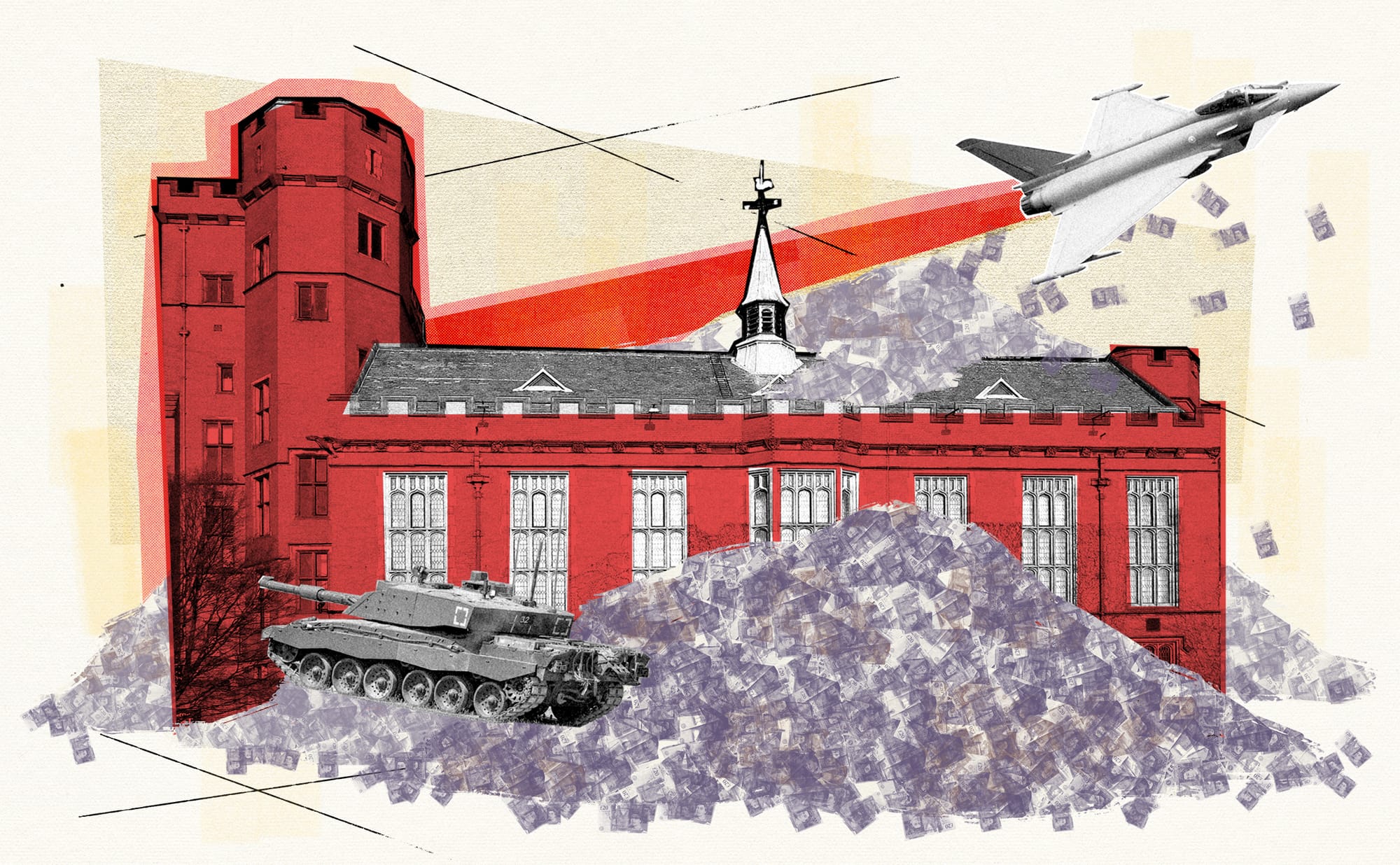
Earlier this month, as a slightly haunting group photo on the government’s website attests, UK defence minister Luke Pollard and representatives from 35 universities gathered in Manchester, to celebrate the formation of a new organisation. Depending on who you ask, it was either the birth of an exciting and innovative collaboration, or an unholy alliance: the Defence Universities Alliance (DUA), to use the group’s official name.
The DUA’s goals are straightforward: advance defence-related research at universities and encourage more top students into jobs in the sector. It’s no surprise that the University of Sheffield was selected from 100 applicants to become one of the DUA’s founding members. The city it belongs to has long tied its fortunes to the industry of war; in 1918, Sheffield was nicknamed the ‘Arsenal of the World’ because of the armaments shipped out to military forces across the globe.
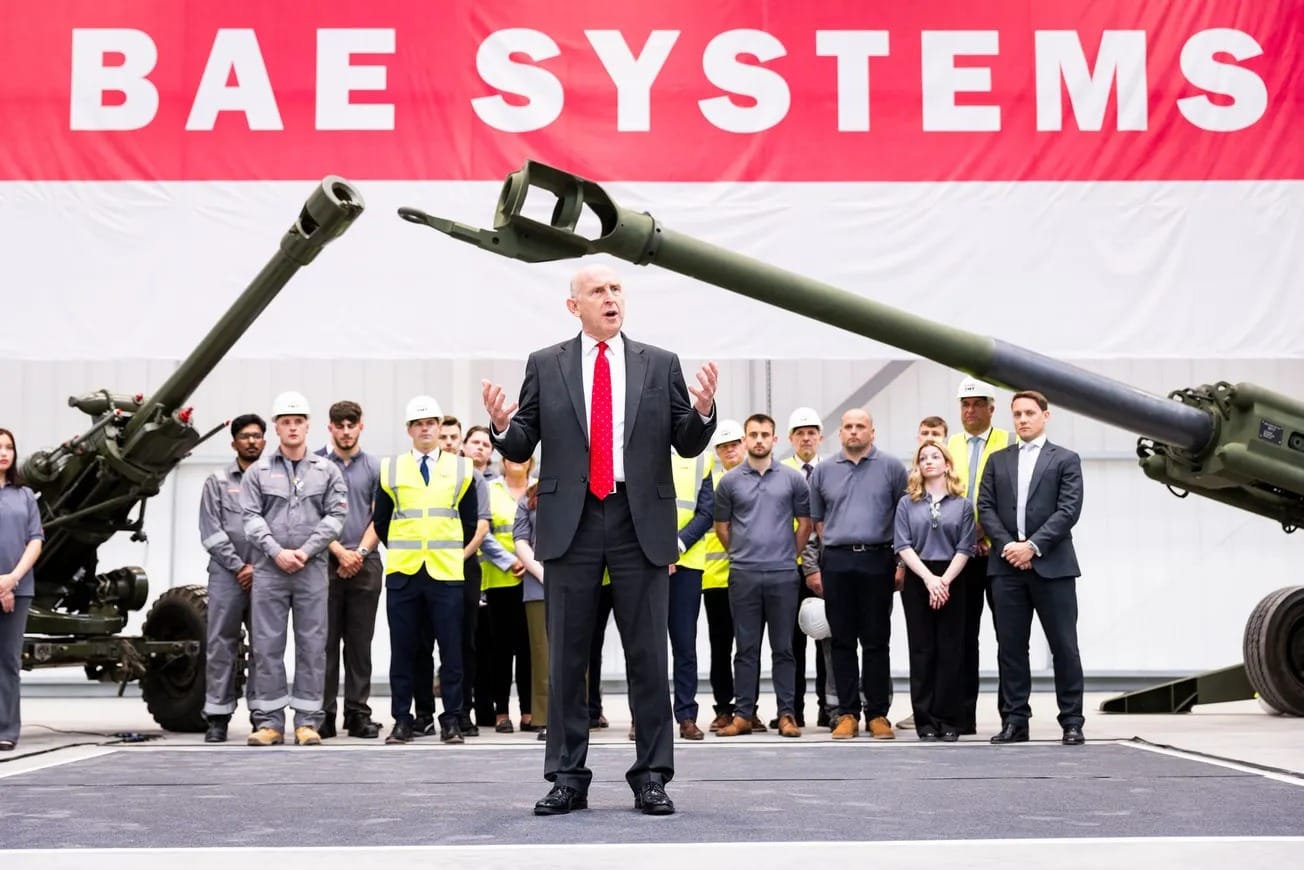
In the 21st century, little has shifted. When BAE systems opened its new factory in Tinsley last year, former UK defence secretary (and now chancellor) John Healey, held it up as proof that Sheffield is still a city of makers. “Too often in recent decades, the story of this region has been saying goodbye to industry,” he said, “and that’s changing.”
As for the University of Sheffield itself, a closely entwined relationship with the defence sector goes back to its very beginnings, with a key constituent college founded and financed by a Victorian arms industrialist. These links continue; in 2025, we exclusively revealed that for years, the university has been helping to develop the UK’s next nuclear warheads, inside a secret cell based within the Advanced Manufacturing Research Centre (AMRC) in Rotherham (mirroring academics who consulted on munitions production during World War I).
But joining this new alliance formalises such a partnership in black and white. DUA sign-ups agree to a charter with the UK government. As well as investing in research and development for defence, the University of Sheffield has promised to ensure careers in the defence sector are “promoted as part of a balanced portfolio of impartial careers guidance” (oxymoronic, some would say), and has committed to “rais[ing] awareness of [...] the importance of supporting Defence and National Security outcomes”.
In return, the institution is hoping for a very handsome payday: the DUA’s formation is part of a £298 billion pound government defence package. While there’s been no firm communication on exactly how much of that the 35 member universities will receive, in an era of constant academic cuts, it’s certainly a tempting carrot.
And the University of Sheffield has already found defence to be a rare abundant funding pot; in June it was awarded £2.7 million by the Ministry of Defence and the Office for Students to create 300 new places on courses in civil and mechanical engineering. The same month, Demilitarise Education (dED), a national campaign to remove arms money from higher education, produced their annual report, which named the University of Sheffield as the UK’s “top militarised university”. dED calculated the university had earned £534m in partnerships with the defence sector between 2018 to 2025.
Is it all worth it? Y’know… morally?
Is the university making war weapons?
Our reporting that AMRC was helping to develop nuclear warheads, prompted “a lot of outrage” among academics at the university, I’m told. So much so that, in August, around two dozen gathered outside the gates of the AMRC to protest against the university’s role in developing weapons of mass destruction.
But according to Professor Conchúr Ó Brádaigh, the university’s head of engineering and the man leading its work on the DUA, there has been no such outcry this time. “I think there is a lot of acceptance and movement towards understanding that this is something we need to be involved in, and that we can make a big contribution to the UK,” he says, talking to me from his office in the university’s beautiful Mappin building.

There are some who would disagree with this assessment. Dr David Hayes, a senior lecturer in law and the president of the university’s branch of the University and College Union (UCU), says he personally finds it very concerning that his employer is now “in the pockets of big defence”. Sociology lecturer Dr Annapurna Menon says the announcement “set off some alarm bells” among her colleagues. “There is a lot of opposition to it,” she says, “and a growing notion that the production of weapons is not really sustainable and it puts us all at risk. That’s why Sheffield got bombed in World War Two, do we really want to be making more weapons?”
Sheffield’s UCU branch recently held a meeting with members and found there was a significant chunk “who don’t want our research to be used in military engagement at all”. The branch decided they want the university to survey all academic staff on their feelings about their employer’s links to the arms industry; the university has not yet responded to this demand.
In October, The University of Sheffield was forced to clarify that it “fully supports” the right to peaceful protest after Liberty Investigates revealed that four students received a fine as part of disciplinary action for disrupting an online event by posting phrases such as “BAE kills kids”. A student told Liberty: “You’re essentially being asked to pay for your right to protest.” Campaigns like Demilitarise Education, have lasered in on Sheffield. dED founder Jinsella Kennaway, has condemned the Defence University Alliance, saying universities “exist to advance knowledge and foster critical inquiry, not to become pipelines for military research and defence recruitment”.
But Ó Brádaigh insists that the university will not be getting any blood on its hands — at least not directly. “We’re not involved in the development of any kind of weapon systems that will be deployable,” he says.
I push him on this: does he know exactly where the university’s technology ends up?
This story is free to read. You just need to sign up to join The Tribune's mailing list. And why wouldn't you? You'll get our journalism in your inbox the second we publish, keeping up to date on this and all our stories. No card details required.
Already have an account? Sign In