
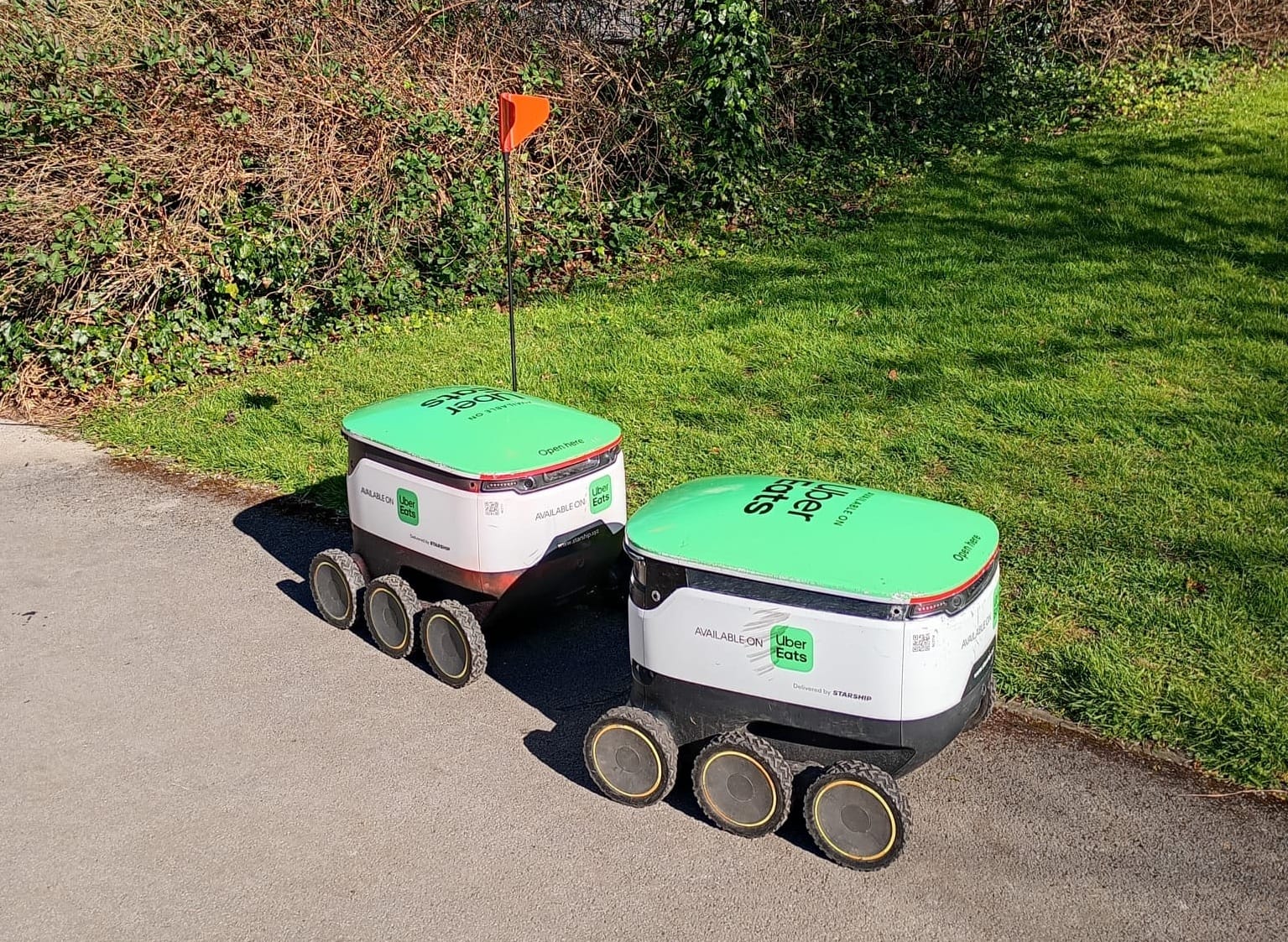
They arrived in Meersbrook in the middle of last month, hungry for work. So far, they’ve found a bit, but seemingly not that much. Residents tell me they spend most of the day sitting in tight huddles in the local parks, before retreating to the camp they’ve set up outside the scout hut at night. Their cameras are always at the ready, although it’s not clear when they’re filming and when they’re not. “They’re waiting outside houses, just staring at them,” one mum tells me. “It genuinely feels icky.”
An infographic with alarming claims quickly began circulating on local Facebook groups. “Do you know what’s happening on our streets?” it begins. “No one has formally approved this — it has simply been allowed to happen.” It warned that, though there might be only a few new arrivals at the moment, they will certainly become “more numerous” if the community doesn’t push back now. Residents should contact the council, the local press and encourage their neighbours to do the same. “The more voices, the better.”
Of course, there was pushback to the pushback. This was scaremongering, this was backwards thinking, this was why Sheffield can’t have nice things. It was the Ofo bikes all over again. The people of Meersbrook — a supportive, tightknit community by all accounts — seemed to be turning on each other. “Never had you down for a capitalist hypocrite,” one seething comment reads. “It got a bit nasty,” one woman, who declined to give her name, tells me. “I’ve been called a loony, but I was just trying to make people aware of what’s going on.”
The first time anyone I know spotted an autonomous delivery robot on the streets of Meersbrook was 19 March, when a three-second video of one trundling along was posted in a group chat. (“Did you push it over?” came the first response, quickly followed by: “Kick it to death.”) The robots, created by Starship Technologies, have been delivering shopping for Co-op in Milton Keynes, Manchester and Leeds since 2018. They arrived in parts of southern Sheffield last month, for a trial partnership with UberEats.
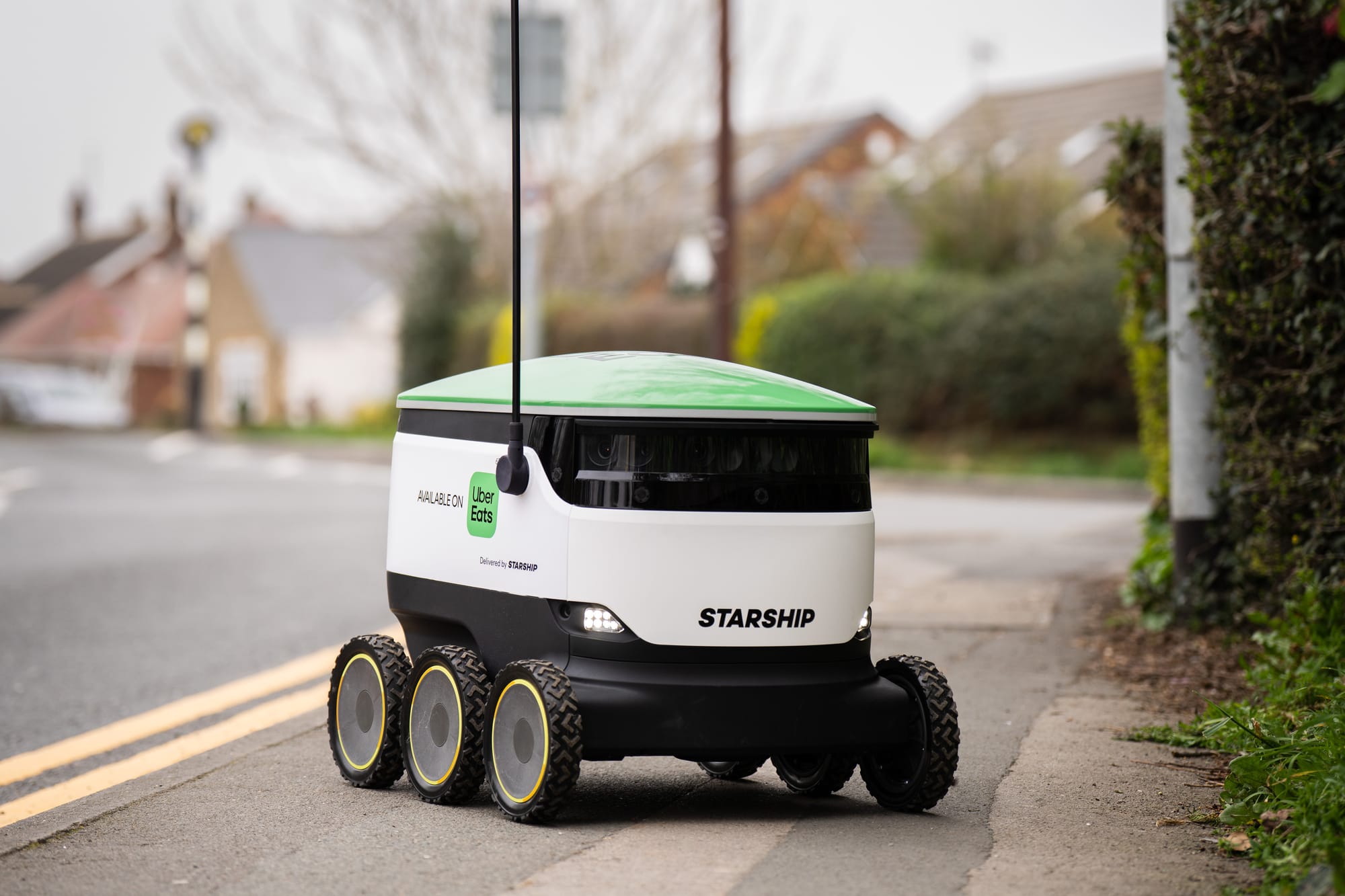
On the phone, Lisa Johnson from Starship Technologies tells me there are currently around 15 robots allocated to Sheffield, covering a swathe of the city that stretches as far as Gleadless, although only six tend to be out on the streets at any one time. She’s unwilling to disclose how much they cost each but “it’s less than a car and more than a very expensive laptop”. Though they are comfortable with all sorts of terrain — “trams, traffic, snow, these robots can manage it,” she says cheerfully — Starship like to make sure they debut in “slightly easier environments” when arriving in a new city, such as ones with lower footfall.
But have these robots ever navigated terrain as hostile as Meersbrook? Within weeks of their arrival, two of the ‘Meersbots’ were vandalised, their aerials ripped off and slogans like “off our streets” spraypainted on them. Local resident Alex Maxwell tells me he recently came across a woman tipping one on its side so it couldn’t carry out deliveries; the saboteur argued it was an act of “non-destructive civil disobedience”.
Maxwell says he’s not a “robot booster,” but doesn’t think such measures will stop the (very slow) march of the machines. “There’s very few examples where a little bit of civil disobedience has put off a big tech company.”
Starship acknowledges there have been a few instances of vandalism; Johnson claims these were reported to the police (although she never responds when I ask for the incident numbers). “It’s disappointing, particularly as someone from the north,” she says. “I want to see northern cities benefit and everyone should have access to technology and innovation.”
Maybe it’s got something to do with how suddenly they appeared, I suggest, something residents have taken specific issue with. This is an established Starship strategy, Johnson explains. “Quite often, if we do engagement before we launch in an area, then it’s difficult to talk about how they operate”. Only now that the robots have landed does the company plan to hold drop-in sessions and take them into local schools — although Johnson is unable to give me dates for when this might take place. She’s keen to stress that this kind of pushback is far from typical. “Broadly, we experience really high levels of acceptance. In Cambridge, 93% of people surveyed said they like them.”
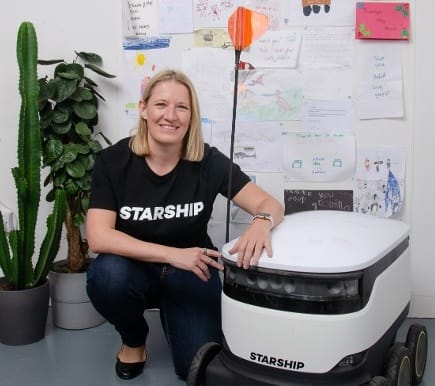
So why the outrage in Meersbrook? Wrong place, says local mum Victoria Billingham. “If I saw it in the city centre, I wouldn’t bat an eye, I’d just think it’s a sign we live in a modern city.” But autonomous robots, she argues, just don’t “fit the sentiment of a lot of people in Meersbrook,” although she struggles to describe that sentiment when I ask. It’s a “community driven” area, she eventually muses, and “quite political”.
One of the most common objections to the robots — and the issue Billingham is particularly concerned by — are the cameras dotted all over their bodies, which they use to navigate. “On a fundamental level, it feels like a big invasion of privacy,” she says. “Everyone I speak to says the same thing really.” A technician who comes to check on the robots every morning (presumably performing CPR on those who’ve been attacked) told her the cameras “only come on when they cross the road,” although my conversation with Johnson suggests this isn’t quite accurate.
But lingering uncertainty at how much footage they’re collecting, and what it’s used for has left many uneasy. “I hate having all those cameras around my children,” adds Billingham. “It’s almost like an eye turned on them.”
Jim Freeman, another Meersbrook resident, balks at the carte blanche given to the robots. “If I was to walk around the neighbourhood constantly filming people and their houses, the police would get called,” he gripes. “I don’t understand why we constantly make exceptions for large corporations that we would not make for normal people.”
On Alex Maxwell’s part, he gets the worry about cameras but believes the fight against being filmed in public is one already lost. “Ring doorbells are normalised, dash cams are normalised, we’ve got private contractors walking round with body cams. Unfortunately, I think we are past that, which isn’t great.” He also finds it slightly odd that people are arguing about data privacy in conversations on Facebook, given Meta profits from its users' personal data in far more alarming ways. “If you’re jumping on your local Facebook group to denounce robots surveilling the neighbourhood, then that’s either naivety or hypocrisy.”
On Starship’s end, Lisa Johnson says she totally understands the concerns. “In the world we live in, data privacy is so important,” she says. Starship Technologies does not share its camera footage with partners like UberEats and only uses the data internally to train the robots or “when there’s been an incident,” such as a collision (this leaves me wondering if the robots have been filming their own assaults). While police could theoretically request footage to investigate a crime, she’s unaware of any instances where this has happened. “The robot is at knee height so it’s mostly seeing people’s feet and knees,” she says. “They’re delivery robots, not surveillance equipment.”
She’s even firmer in her contention of another argument the Meersbrook critics are wielding against the robots: that they’re stealing people’s jobs. “Two hundred years ago, local shops would have a lad on a bike delivering things, but telephones and cars changed how people shop and then online delivery changed everything again. Even ten years ago, no one would have thought of ordering a coffee on demand the way we do now.”
People expect goods delivered to their door, quickly and at all hours, Johnson says; thus the current system is unsustainable. “Cities are already struggling with congestion but people want more stuff delivered — this is part of the solution. If you work in retail, there’s a massive demand and you can’t pay everyone fairly, then how do you meet the small orders people want?”
Jim Freeman is unconvinced. "People seem to conflate progress with people making more money,” he says. “If a business can’t pay someone properly for deliveries, maybe they should try making less profit.” He points to Uber specifically, saying the company is “entirely built on paying the least they can and charging the most, so obviously this works for them.”
Despite his largely neutral position, Maxwell is sceptical that the gap between labour supply and delivery demand is all that large in an area like Meersbrook. “I’ve never seen them actually complete a trip, they seem to be lost or inactive more times than not. I can’t see them sticking around because I don’t think they’re necessarily working.”
A friend in Woodseats ordered from one of the robots recently, he tells me, only for the delivery to take an hour and a half as it struggled to navigate the local area. I relay my intel from Starship that the robots can reach a whopping top speed of six miles per hour, but tend to travel at average of 3.3mph, out of caution. “I can’t see them being amazingly efficient,” Maxwell says dryly, “and I imagine they’re fairly expensive to run.”
I decide to experiment, to see if I’m able to stop worrying and learn to love the bot. Immediately, I run into the snag that only a few takeaway vendors are currently signed up for robot deliveries, meaning I spend almost half an hour clicking through options in Meersbrook until I find one — which turns out to be exactly three doors away from my friend’s home.
We stand outside her door watching as a robot comes to the stop in the middle of the pavement and waits expectantly while three separate employees try to work out how to coax it open. My order of fish and chips arrives still warm, although this isn’t much of an achievement given the distance it’s had to travel. After we remove our food, a man passing on the street tries to encourage his dog to piss on the robot and, as if it has overheard, it promptly zips away.
As for financial benefits, the consumer sees none: I’m still charged a delivery and service fee, although the app cheerfully informs me I will not have to pay the money I was willing to tip the driver.
Beneath practical concerns about privacy and local jobs, however, it seems the biggest reason people object to the robots is more emotional. “It’s a little bit about the shock of the new,” Maxwell suggests. Victoria Billingham says a large part of her opposition is likely because she’s “more nature-oriented, so I don’t like having robots sat at the entrance to a really beautiful park. We’ve got the first spring flowers coming out and then these awful robots there.”
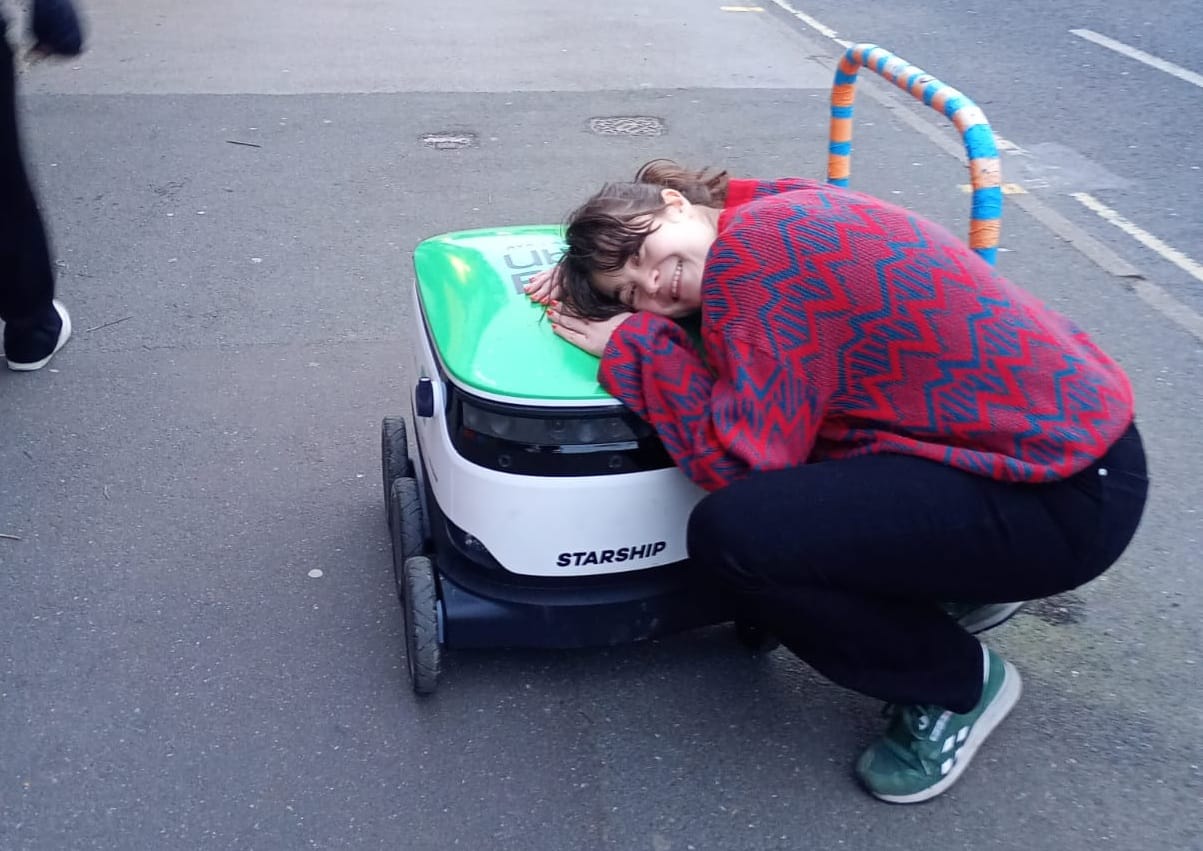
Even the rather naked attempts to make the robots endearing — such as decorative stickers stuck to them for major holidays — only serve to make them more unnerving in her eyes. “They're all cute and playful with children but I don’t think children should grow up thinking a random robot with a camera is friendly,” she says. “Maybe that’s my tin foil hat.” The other day, she adds, she overheard a woman on the street tell her friend off for talking about one as if it was a person. “As soon as we start anthropomorphising them, we are done, they are here forever.”
Intriguingly, one of the main rumours doing the rounds in Meersbrook — that the council were not informed about the trial — seems to be false. While Sheffield council had yet to respond to a request for comment at the time of writing, and though the area's ward councillors insist they were not notified, Johnson claims the council was in the loop. “Sheffield council embraces innovation, it’s been really good working with them,” she says. “We always engage with local councils because we don’t want to go to an area and annoy people and the council knows the places where it wouldn’t work, perhaps because of antisocial behaviour.” To her knowledge, the council had no objection to any of the areas the company proposed, having never foreseen that “a bag of food on wheels” might turn the law-abiding citizens of Meersbrook into middle-aged delinquents.
That said, there’s already signs that Meersbrook's robot rebellion is losing steam. After a torrent of heated debate in March, posts on the local Facebook group have slowed to a trickle. While only a few takeaways offered robot deliveries when I conducted my test run, Johnson and Starship are confident uptake will “snowball” as time goes on. And, as with any cause, the vast majority of people will likely just not care — even in a politically active area like Meersbrook. At the height of the uproar, I get chatting to a Meersbrook resident of eight years, who tells me he’s only seen people faintly amused by them. “I can see where some people are coming from, I just don’t have the time to give it that much thought and get that worked up,” he says. “There are far worse things in the world right now to worry about than a little robot. But maybe it’s a slippery slope and all that.”
 Victoria Munro
Enjoyed the robot rumble? Read about the blowback faced by the man who evicted one of Sheffield's most iconic venues.